The 1995 growing season was superlative for Cabernet Sauvignon production both in Bordeaux and the Napa Valley. With ripeness being a primary winemaking decision the past few decades, it has been increasingly harder to differentiate the best wines from these two leading wine regions. Six of the best 1995 Cabernet-based wines from each region were pitted against one another in a Bordeaux versus Napa tasting held this winter in Santa Fe.
The impetus for the tasting was a 2011 Santa Fe Wine & Chile Fiesta Live Auction Wine Lot, purchased by Carl and Marilyn Thoma of Van Duzer Vineyards and their friends. The tasting took place at the Thoma’s Santa Fe home with 8 guests taking part. Proceeds from the $12,500 auction lot went to Santa Fe’s public school program, Cooking with Kids.
To pair with this rare tasting, Guest Chef Louis Moskow, chef/owner of Santa Fe’s 315 Restaurant and Wine Bar, prepared a wine-friendly, five-course meal. Champagne Krug and osetra caviar with blinis started the meal in grand fashion.
As part of the lot, I handled the wine service for the evening. Seven of the wines came from my cellar and he other five were donated by friends of the Fiesta so I knew the provenance of each wine was sound. All of the wines scored in the mid-nineties by wine critic Robert Parker.
The twelve 1995s were served in four flights, three wines to a flight. In each flight, there were two wines from one region and one from the other. The wines were served as follows:
Flight #1:
1995 Chateau Grand-Puy-Lacoste (95 points Robert Parker)
1995 Joseph Phelps Insignia Napa (97 RP)
1995 Chateau Calon Segur (92 RP)
Flight #2:
1995 Chateau Leovilles-Las-Cases (95 RP)
1995 Shafer Hillside Select Sauvignon Napa (99 RP)
1995 Chateau Montrose (93 RP)
Flight #3:
1995 Dalla Valle Cabernet Sauvignon Napa (95 RP)
1995 Spottswoode Cabernet Sauvignon Napa (95 RP)
1995 Chateau Cos d’Estournel (95 RP)
Flight #4:
1995 Opus One Napa (93 RP)
1995 Chateau Pichon Lalande (96 RP)
1995 Grigch Hills Cabernet Sauvignon Napa
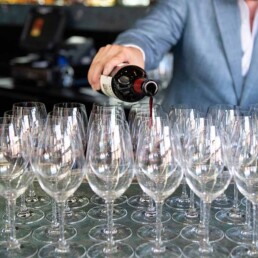
An hour before the guests arrived, I double decanted all the wines: poured into a decanter and then poured back into the bottle after cleaning the bottle of sediment. The fills on each bottle were above the neck, showing no evaporation. Ten of the corks came out whole; only the Insignia and Opus corks were dried out but both came out cleanly in two pieces. None of the wines were defective.
As a parlor game, for the first flight of three wines — the 1995 Chateau Grand Puy Lacoste, Chateau Calon Segur and Joseph Phelps Insignia – was served blind and I asked the guests to pick which wine was the Insignia. Guests were able to read the printed menu at their individual settings at the large round table under the dining room’s kiva ceiling, so they knew the wines of the flight in front of them, but they didn’t know which wine was which.
Five of the 8 diners picked out the Insignia correctly. Louis named all three wines correctly, saying that the Insignia showed itself as the new world wine because “it was clean and had no low tide stink like on the Calon Segur and had no lead pencil aroma as on the Grand Puy.” The Grand Puy Lacoste had a black currant, lead pencil, Pauillac nose that is so familiar with this wine. It struck an emotional note with Louis; he noted he has enjoyed this wine since his childhood with his father.
All 8 diners and chef Louis and I agreed that second flight of three wines – the Spottswoode, Dalla Valle and Cos d’Estournel — made for the flight of the night. All three were superb with chef’s duck course. The Cos was in perfect form, with a compelling low tide stink similar but more friendly and less pronounced as in the other St. Estephe that preceded it, the Calon Segur. The Cos also had had telltale tobacco, lead pencil and red fruits in the nose. On the palate, the Cos finish was long and complex, echoing the nose.
The Dalla Valle showed new world power and exuberance in the nose and palate and exhibited the strongest extraction of the lineup of 12 – forward, brightly red-fruited and cheery, it stepped up as the buxom blond hey-look-at-me wine of the night.
The Spottswoode 95 was a hypothetical blend of the two, showing the old world complexity of the Cos and the Napa strength of the Dalla Valle, combining finesse and power and finishing with seamless tannins. Louis noted that the 95 was one of his favorite Spottswoode Cabernet’s he has had, and it was in fine form tonight, exhibiting a long and complex finish.
The three wines that followed with the grilled ribeye course – the Leovilles Las Cass, Shafer Hillside and Montrose — were all well chosen as partners in their flight. All three had the strongest tannins of the twelve 1995 wines served.
Marilyn, myself, and even Louis on first taste, all asked out loud where the fruit was in
the Leoville. At the end of the night, Louis and I disagreed that the fruit in the Leoville would ever show itself. Marilyn felt it was gone while Louis felt it was still hidden in a very young wine. Given that my anticipation was so high, I was somewhat disappointed in the Leoville.
The Shafer, a wine I rarely if ever have been able to detect a vintage variation in (given its always fully stuffed character of high ripeness, extraction and powerful oak yet with seamless integration), was also disappointing in that it was somewhat quiet this night. At first sniff, it had its typical port like nose, but later when served, it was short on the finish and showing a drying tannic profile. Perhaps a bad bottle?
The Montrose was my favorite wine of this third flight, having more power that the Cos while having it’s same aromatic complexity. I liked the Montrose for the very same reason I did the Spottswoode – finesse balance with power.
The last flight, served with the cheese, perhaps did not get the attention it deserved, considering that we had just finished 9 other cabernets. I will say that I was surprised the Opus 95 did not show the brettanomyces that I have always found in this vintage of Opus. It is accepted that Opus at one point in their winemaking history used to force a bit of brett in their wine to give it old world complexity. My favorite wine of this last flight was the Pichon Lalande, a red-fruited wine with a seductive nose and silky tannins.
The Grgich I did not taste (I was busy doing dishes), but Louis noted a slight defect of volatile acidity, which many tasters said they enjoyed with the cheese. My favorite three wines of the night were the Pichon, the Spottswoode and the Montrose in that order. Louis’ top three were the Spottswoode, the Leoville and the Dalle Valla.
All of the guests agreed that it was hard to discern a difference between the two regions, saying all the wines showed favorably. Carl Thoma summed up the evening, “all the wines tonight showed themselves well, each was youthful and with plenty of life ahead. Those who might have thought California wines age quicker than Bordeaux would be surprised!”